


Photo by Diana Polekhina on Unsplash. Unsplash licence.
In 1995, headlines scared thousands of women around the world when they said that contraceptive pills double the risk of blood clots. But ‘double’ is a relative risk. We need to ask “double what?”
Without the pill: Out of 7,000 women, 1 is expected to develop blood clots in a year. (This is the absolute risk in the non-exposed group or baseline risk).
With the pill: Out of 7,000 women, 2 will likely develop blood clots in a year. This is one additional case per 7,000 users. (This is the absolute risk in the exposed group).
Relative risks are not enough to guide decisions since they don’t give any information about the size of the risk – only indicate how larger or smaller is one risk relative to another. For informed decisions, we need to know the absolute risks (probabilities) in all groups compared, e.g. people taking vs not-taking a medicine.
Absolute and relative risk
Absolute risk is the actual probability of an event occurring. When comparing groups, there are two absolute risks to communicate:
Relative risks indicate how much larger or smaller one number is relative to another, but they not provide any information about the real likelihood of an event occurring. They result from dividing the absolute risk in the exposed group by the absolute risk in the unexposed group.
Useful Resources:

Understand relative vs absolute risks. Watch Prof. David Spiegelhalter explaining why relative risks are misleading, and how to communicate absolute risks using everyday examples like contraceptive pills and bacon. Produced by the Winton Centre.

Decoding Hazard Ratios (HR) and Odds Ratios (OR). Explore these common types of relative risks in research and get a clear understanding with engaging real-world examples. Produced by the Winton Centre.
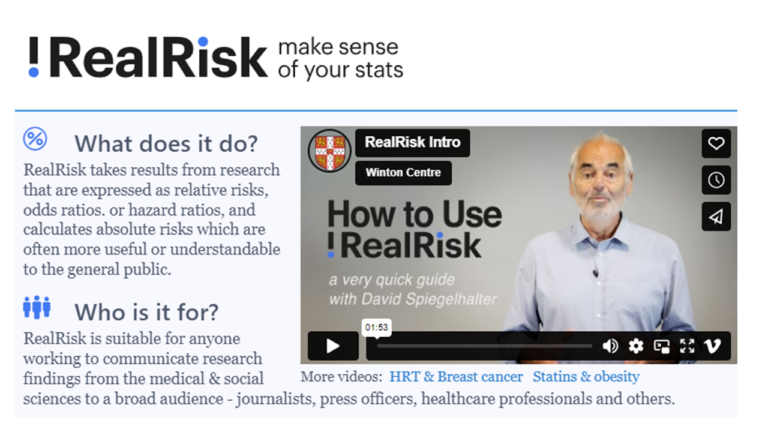
RealRisk takes research results like relative risks, odds ratios, and hazard ratios, and translates them into clear graphics and calculated absolute risks. Produced by the Winton Centre.