

Home | Framework | Understand The Numbers | Conditional Probabilities | Recognise when one number needs another: conditional probabilities
Share:
Conditional Probabilities

Recognise when one number needs another: conditional probabilities

You receive a emergency threat alert at 2:30am. Given the alert, and considering past system glitches, what’s the real probability it’s an actual threat?

Photo by Photography Mahi on Unsplash. Unsplash licence.

Historically, the system has a false alarm once every 100 alerts, meaning 99 out of 100 times, the alert is real.
However, based on data from the local police, you know that only 1 in 10 real alerts corresponds to an actual threat.
Given the alert and considering past false alarms, what’s the real probability it’s an actual credible threat? The answer depends on two probabilities.
1- Probability that the alert is real given the system’s false alarm rate: 99/100 or 0.99.
2- Probability that a real alert corresponds to a credible threat based on past patterns: 1/10 or 0.10.
Now, the term ‘conditional’ here means that one probability (the threat being credible) is dependent on another condition (the alert being real). Thus, to find out the probability of an actual threat given the alert:
The probability that it’s a real credible threat given an alert is: 0.99 (probability it’s a real alert) x 0.10 (probability a real alert is a credible threat) = 0.099 or 9.9%.
A real alert doesn’t always mean a real threat. The credibility of the threat is ‘conditional’ on the alert being genuine.
Remember! Some probabilities result from the calculation of two probabilities. Understanding this is essential for interpreting certain safety systems and test results.

False positives and negatives

You may have come across terms like *”false positives” and “false negatives” in discussions about medical tests. These are conditional probabilities; understanding them can guide us to make the right decisions.
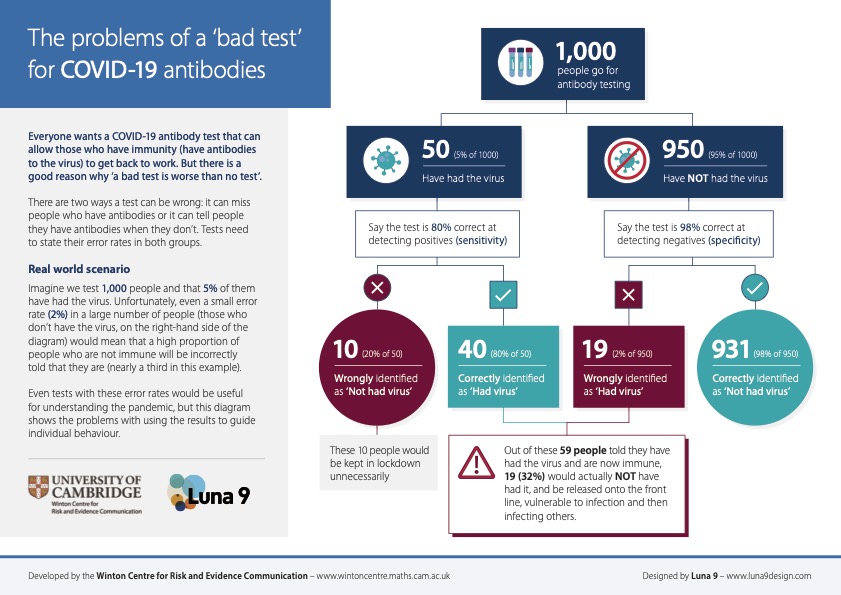
During the pandemic, many considered the Covid antibody test, hoping it could potentially allow those with immunity to end their lockdowns and return to work. However, understanding conditional probabilities revealed this was not a good idea.
False positive:
When a test incorrectly indicates the presence of a condition.
False negative:
When a test mistakenly indicates the absence of a condition.

Useful Resources:

The infographic in this article illustrates why a test, which fails to detect 2% of individuals uninfected by the virus, could mean that a third of those told they’ve had the virus actually haven’t. Such people would be released to the frontlines, still susceptible to infection. Also available in Spanish. Produced by the Winton Centre.

Also available in Spanish

These options may help you use our website more easily. For more information please check our accessibility statement.

  • Large text
  • Low contrast
  • Dark mode
  • Reduced motion