

Home | Framework | Think Beyond The Numbers | Cognitive Bias and Patterns in Randomness | You can’t rely on your instincts
Share:
Cognitive Bias and Patterns in Randomness

You can’t rely on your instincts

Just because it hasn’t happened, it doesn’t mean it won’t. And just because you see a pattern, it doesn’t mean it’s real.

Photo by Maulana Ahmad on Unsplash. Unsplash licence. 

In a Mexico City neighbourhood, Sr. García dismissed advice to inspect his home despite visible cracks, confidently stating, “My house has stood for decades.” A year later, an unexpected earthquake struck, impacting his neighbourhood, including his house.

Risks don’t necessarily adhere to our perceptions or past experiences. Just because you’ve been safe in the past doesn’t mean you always will be.

Cognitive bias

Cognitive bias is when our minds make mistakes in how we think about things. Instead of seeing things objectively, we might rely too much on our past experiences or feelings.

There are several types of cognitive bias. Some of them are:

Confirmation bias occurs when a person looks for information that backs up their existing beliefs or assumptions. Eg. “See, this news article confirms that vaccines are dangerous, just as I suspected.”

Optimism bias occurs when people perceive that they are at a lower risk than others of experiencing a negative event. In other words, when a person thinks that bad things can happen to others but not to them. E.g. “My house won’t be affected by floods”.

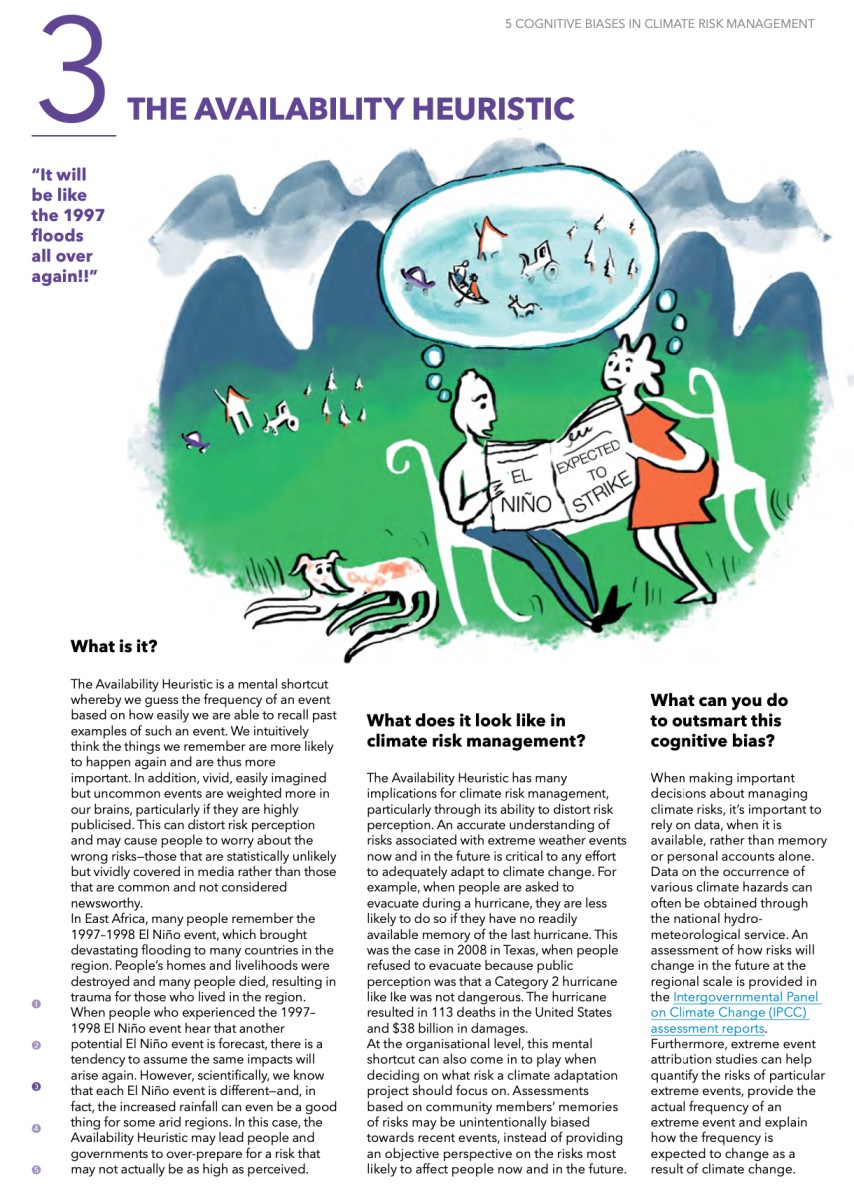
Availability bias (also The Availability Heuristic) occurs when a person guesses the frequency of an event based on how easily they can recall past examples of such event. This can lead to overestimating the likelihood of events that are vividly covered in the media, while underestimating more common but less memorable events. E.g. individuals may be less inclined to evacuate during a hurricane if they have no recent memory of one occurring.

Patterns in randomness refers to the apparent order or predictability that people observe in a situation that is inherently random. E.g. In Mexico City there was a severe earthquake on 19 Sep 1985, and there was another on the exact same date but in 2017. People were suspecting that earthquakes are more likely to occur in September, when they are indeed random and non-predictable events.

After the 2015 [Nepal] earthquakes, the communities saw the concrete buildings that had survived as the buildings they would feel safe living in. [However,] in a different earthquake many of those would not have been safe either.
Alejandra Albuerne, Architectural engineer and construction historian

Useful Resources:

This series of infographics show cognitive biases about climate change, ranging from the misconception that a single action can sufficiently mitigate its effects to the belief that climate events won’t impact oneself. It illustrates how our instincts and automatic judgments can lead people to make incorrect decisions.

Produced by Roop Singh and Rebeka Ryvola,

Red Cross Red Crescent Climate Centre; and BRACED.

These options may help you use our website more easily. For more information please check our accessibility statement.

  • Large text
  • Low contrast
  • Dark mode
  • Reduced motion