
Photo by CHUTTERSNAP on Unsplash. Unsplash licence.
Every day, 100 accidents occur on Route Z. This is informative for local authorities who must redesign the route and work on traffic regulations.
But what about the regular commuter? For an individual contemplating their daily drive on Route Z, a more meaningful measure for personal decision-making is this: 1 in 5,000 commuters on Route Z experience an accident each day.
Of course, individual risk varies and it’s not possible to predict the risk of a specific person. For instance, if you’re not adhering to traffic regulations or if you’re a less attentive driver, your personal risk might be higher. But understanding both the population-wide impact and the individual’s perspective gives a more holistic view of the situation.
A risk can be very concerning from a population perspective yet seem minimal from an individual perspective, and vice versa.
Women we spoke to found it very difficult to contextualize risk. For example, women who are living with obesity are constantly being told that they are at higher risk of a poor outcome but are never told by how much and what that means in absolute terms. Risks are extrapolated from large scale epidemiological studies and then applied to an individual in a clinical setting, but without describing how that risk is calculated and translated to an individual, it’s very difficult for them to contextualize it.
Rebecca Blaylock, Research and Engagement Lead, Centre for Reproductive Research & Communication, British Pregnancy Advisory Service (BPAS), UK
A paper in The Lancet, a medical journal, presented findings estimating that HRT could have been a contributor to approximately 1 million breast cancer cases globally since 1990. While these figures painted a concerning picture from a public health standpoint, they weren’t necessarily instructive for individual decision-making. As a result, many women grappled with uncertainty regarding the continuation of their treatments.
In response to the paper, this article tried to break down the risk for an individual. The article employed an ‘icon array’ – a visual tool to help understand the magnitude of the risk in a more tangible and relatable manner.
Useful Resources:
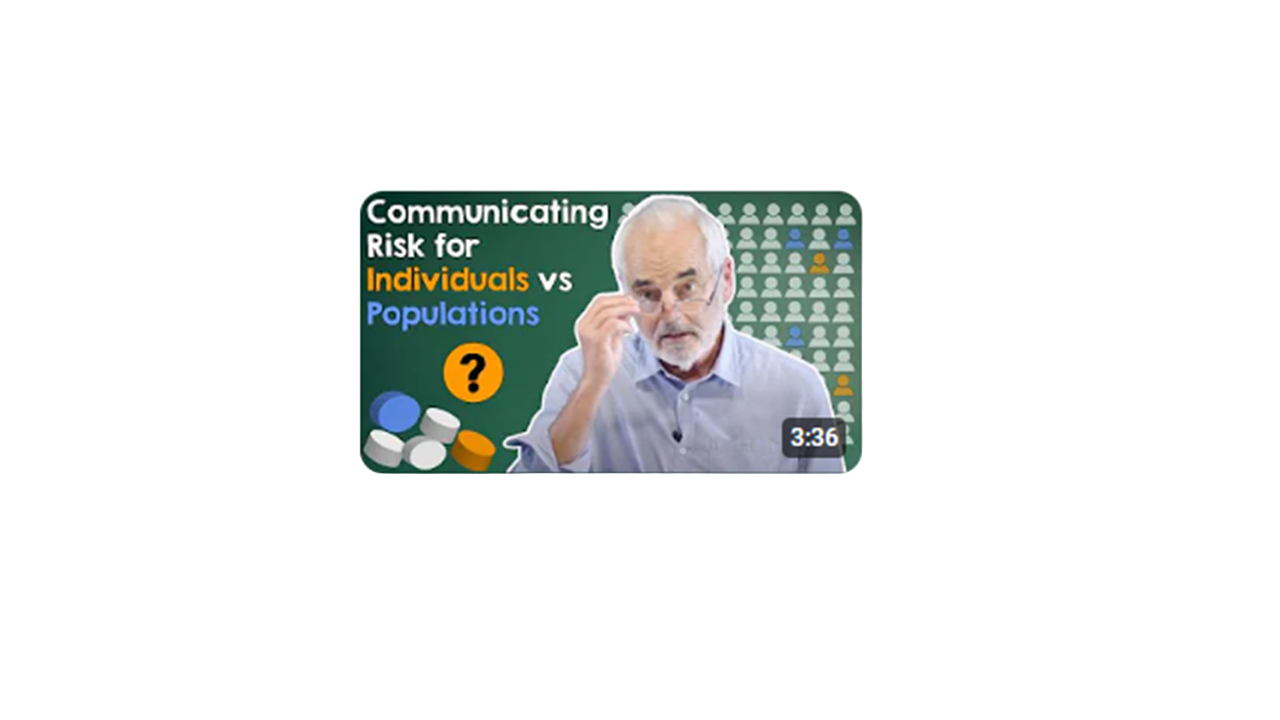
In this video, Prof. David Spiegelhalter explains the nuances of interpreting risks from both an individual and population perspective. Produced by the Winton Centre.